
If you’ve been comparing salon suite vs booth rental, there’s a decent chance you assume they’re basically the same thing. A lot of stylists do.
Both get you out of the commission salon.
Both let you work for yourself.
But the actual day-to-day experience of each model is pretty different — and signing up for the wrong one at the wrong stage of your career costs more than just money.
The U.S. salon industry is expected to reach $92.5 billion in 2026, and nearly 48% of hairdressers, hairstylists, and cosmetologists are now self-employed, according to the U.S. Bureau of Labor Statistics. More beauty professionals are running their own businesses now than ever.
The question isn’t whether to go independent, it’s how you’ll accomplish this. Here’s what you need to know before deciding.
What is booth rental?
Booth rental means you pay for a station or chair inside an existing salon and operate as an independent professional. You’re not an employee. You’re a business owner inside someone else’s building.
The classic booth rental model is straightforward: you pay the salon owner a flat weekly or monthly fee, everything you earn above that is yours, and nobody takes a percentage of your services. You set your prices, you manage your clients, you keep your revenue. That’s it.
That’s the traditional definition. In practice, the term gets used loosely — and that’s where a lot of stylists get burned.
Some salons advertise “booth rental” but structure it more like a commission arrangement. You might pay a lower base fee, but the salon also takes a cut of your service revenue on top of it. Others charge a flat fee but layer in restrictions that quietly limit how independently you actually work: required product lines, set hours, approval on pricing, rules about how you can market yourself.
Before you sign anything, get clear on which version you’re actually agreeing to:
- Flat fee only — you pay a fixed weekly or monthly amount and keep everything above it. Your income is yours to build. This is true booth rental.
- Commission split — the salon takes a percentage of your service revenue before you see it. When you have a great week, so do they.
- Hybrid — a lower base fee plus a revenue split. Common, and worth scrutinizing closely.
The practical difference matters. In a pure flat-fee setup, a busy week is entirely yours. In a commission or hybrid setup, the salon owner benefits every time you do — which starts to feel a lot like the employment model you were trying to leave.
The other thing to understand is what “independent” actually means in a booth rental environment. You’re working on a shared floor. The salon’s name is above the door. Clients often book “at the salon” rather than with you specifically. You may have limited say over the products on the shelves, the music playing, or how the waiting area looks. Your brand exists inside someone else’s.
For a lot of stylists leaving commission salons for the first time, that tradeoff is fine. Less overhead, less operational responsibility, more of your earnings than before. Booth rental is where independence starts for many people. Just know exactly what you’re getting into.
What is a salon suite?
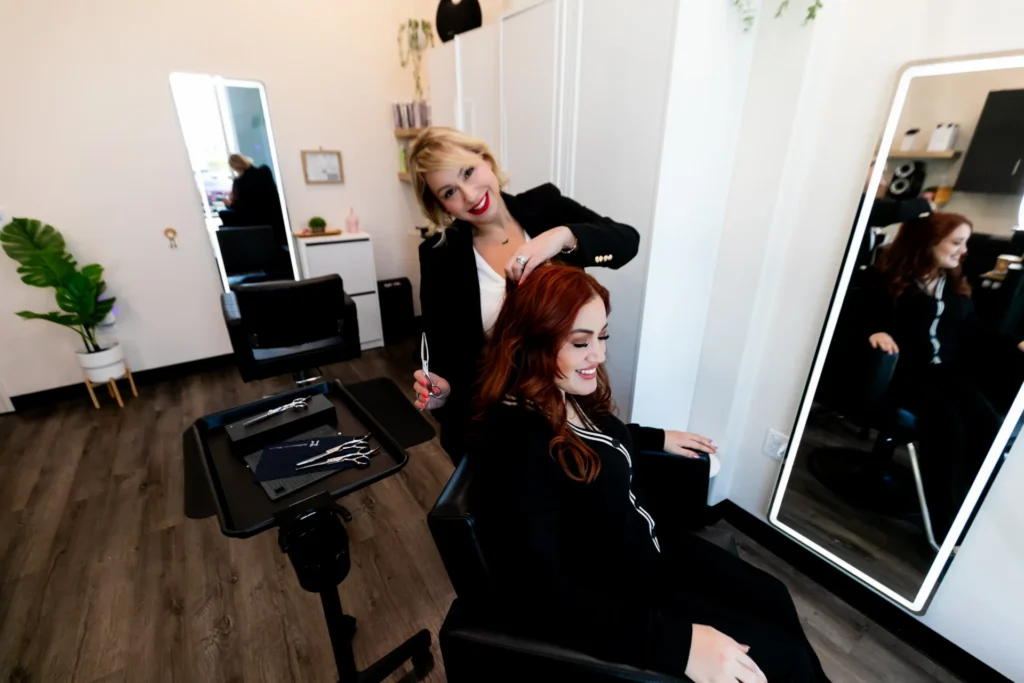
A salon suite is a private, individual space where you run your own business. Not a station on a shared floor — your own room, your own door, your own brand on the wall.
Clients walk into your environment. You set the hours, the music, the pricing, and the policies. The booking experience, the consultation, the retail display, the follow-up — all of it belongs to you.
Phenix’s Salon Suites are built around this model. Here’s what that looks like in practice:
- Private salon spaces with basic equipment included, so you’re not starting from zero
- Your own brand — decor, name, and client experience are entirely your call
- Month-to-month agreements instead of long-term commitments, so you’re not locked in while you find your footing
- Complimentary education and business development tools
- Product discounts to help manage supply costs
- A community of 15,000+ Lifestyle Professionals who’ve already made this transition
That bullet about month-to-month agreements is worth stopping on. The most common hesitation we hear about salon suites is the commitment — people assume they’re signing away years. Phenix doesn’t work that way. You operate on your own timeline.
Salon suite vs booth rental: key differences
| Booth rental | Phenix Salon Suites | |
| Business model | Independent stylist inside another salon | Independent business in a private salon space |
| Startup cost | Usually lower | Varies; basic equipment included at Phenix |
| Fee structure | Flat fee or commission split | Flat weekly fee |
| Branding control | Limited — you operate inside the salon’s identity | Full control over your name, space, and client experience |
| Privacy | Shared salon floor | Private one-on-one environment |
| Scheduling | Often follows salon hours or floor policies | You set your own hours, with 24/7 building access |
| Retail/product sales | Sometimes restricted by salon policies | Full control over what you sell and at what margin |
| Income | Depends on fee structure and pricing limits | You keep what you earn, minus your own expenses |
Booth rental vs salon suite costs
Booth rental usually looks cheaper at first. The monthly number is lower, and you don’t have to think much about decor or supplies.
The ceiling is the problem. Even in a flat-fee setup, you’re operating inside someone else’s business — which shapes how you price, what you can sell, and how clients perceive you. Under a commission structure, it’s more direct: the salon takes a cut of every service you do. A great month for you is a great month for them.
Things booth rental tends to limit, even with a flat fee:
- How freely you can price your services
- Whether you can sell retail products (and which ones)
- How clients find and book you
- Your ability to raise rates without it becoming a conversation with the owner
A private salon space changes the math. You set your prices. You choose your retail and keep the margin. You build an experience that supports whatever positioning you want — which tends to move average ticket value up over time.
Location matters too. Suite fees, client demand, and what the market can support vary a lot by city. Exploring Phenix locations near you can give you a real sense of the numbers in your market.
Branding control and client experience
Here’s the booth rental reality that doesn’t always get said plainly: your clients are experiencing the salon first, and you second. They booked at “XYZ Salon.” They walked into XYZ Salon’s space, sat in XYZ Salon’s chair, and left thinking about XYZ Salon.
Your work speaks for itself, but the brand memory belongs to the owner.
A private suite flips that. What you actually control:
- The booking process — clients find you, book with you, and show up for you
- The environment — your decor, your music, your aesthetic from the door to the chair
- The consultation — no shared floor noise, no walk-in interruptions, just the client in front of you
- The retail shelf — your product choices, your pricing, your recommendations
- The follow-up — your relationship with that client, not the salon’s
That difference matters especially for service types where the environment is part of the work. Hair salon suite professionals doing color or extensions need time and quiet. Estheticians doing skin treatments need a controlled, private space and Lash artists need a calm environment where clients feel comfortable. A busy shared floor doesn’t reliably offer any of those things.
Privacy, scheduling, and how your money actually works
Booth rental scheduling follows the salon’s rhythm. Walk-ins, other stylists, the front desk, the noise of a full floor. Some people genuinely like that energy. Others find it chips away at the quality of every appointment.
When you have your own suite, you own the calendar:
- Build in consultation time without rushing
- Space appointments the way your workflow actually needs
- Set cancellation and booking policies that protect your time
- Take a day off without telling anyone
Clients notice when an appointment feels unhurried. That tends to translate into stronger rebooking rates and longer client relationships over time.
On income — here’s how the three structures actually compare:
- Commission-based booth rental — the salon takes a percentage of your service revenue before you see it. A busy week costs you more than a slow one.
- Flat-fee booth rental — you keep everything above your fixed payment. Predictable, but your ceiling is still shaped by the environment around you.
- Salon suite — your income after expenses is yours. No splits. No cuts to the house. No one else’s overhead coming out of your earnings.
Retail follows the same logic. Inside a private suite, you choose what to stock, how to price it, and when to recommend it. No salon policy telling you which brands to push, no revenue sharing on products you sell.
When booth rental makes sense
Booth rental is the right call at certain points in a career. It’s not a lesser option — it’s a different stage.
It makes sense if:
- Your client book is still building and higher fixed costs feel risky
- You want a lower-stakes way to leave a commission salon for the first time
- You like the community of a shared floor and aren’t ready to work in isolation
- You want to test independence before taking on full operational responsibility
- You’re still figuring out which services you want to specialize in
For a lot of stylists, booth rental is where the confidence gets built. That’s a real and legitimate use of it.
When a salon suite is the stronger move
Once you have steady rebooking and a client base that follows you specifically — not the salon, not the address, you — a suite stops being a risk and starts being the obvious next step.
Here’s what the model actually gives you:
- Take home 100% of your service earnings, minus your own business costs — no commission splits, no cuts to the house
- Set your own prices without ceiling or approval from a salon owner
- Sell retail and keep the full margin — no shared shelf, no house cut
- Build a brand that’s entirely yours — your name, your aesthetic, your client experience
- Work your own schedule on your own terms
- Specialize without compromise — build the exact practice you want, for the clients who want it
- Own the client relationship — your booking platform, your contact list, your rebooking rates
Phenix makes this more accessible than it used to be. Month-to-month agreements mean you’re not locked into a long-term commitment while you find your footing. You get a private salon space with basic equipment included, plus:
- Complimentary education
- Business development tools product discounts
- A community of 15,000+ Lifestyle Professionals who’ve already made this transition
If you’re thinking seriously about the move, a salon suite startup checklist or a salon suite business plan can help you pressure-test the decision with actual numbers.
Which one is right for you?
Booth rental and salon suites both offer independence. They’re just different versions of it, at different stages of a career.
Booth rental is lower-barrier. You trade some control for less operational responsibility, and for stylists still building their client base, that trade often makes sense.
A salon suite is a different proposition entirely. You own the brand, the environment, and the client experience. You keep what you earn. And with Phenix, you do it without the long-term commitment that used to make the whole thing feel out of reach.
If you’re ready to take that step, find a Phenix location near you or reserve a salon suite to see what’s available in your market.